Hong Kong enters ‘year of the carve-out’ as M&A rebounds
Deal value hit a decade-high $289b in the first quarter.
Hong Kong could see more mergers and acquisitions (M&A) this year as large business groups sell noncore assets to fund expansion, following a sharp rebound in dealmaking after a subdued 2025.
The city is entering its “year of the carve-out,” Angela Chiu, director for corporate finance and M&As at KPMG China, said in an emailed reply to questions.
She noted that companies are increasingly redeploying capital and reshaping portfolios, a trend that could continue through 2027.
Hong Kong-related M&A reached $289b (US$36.9b) in the first quarter, up 47.2% from a year earlier and the strongest first-quarter total in a decade, according to London Stock Exchange Group Plc data.
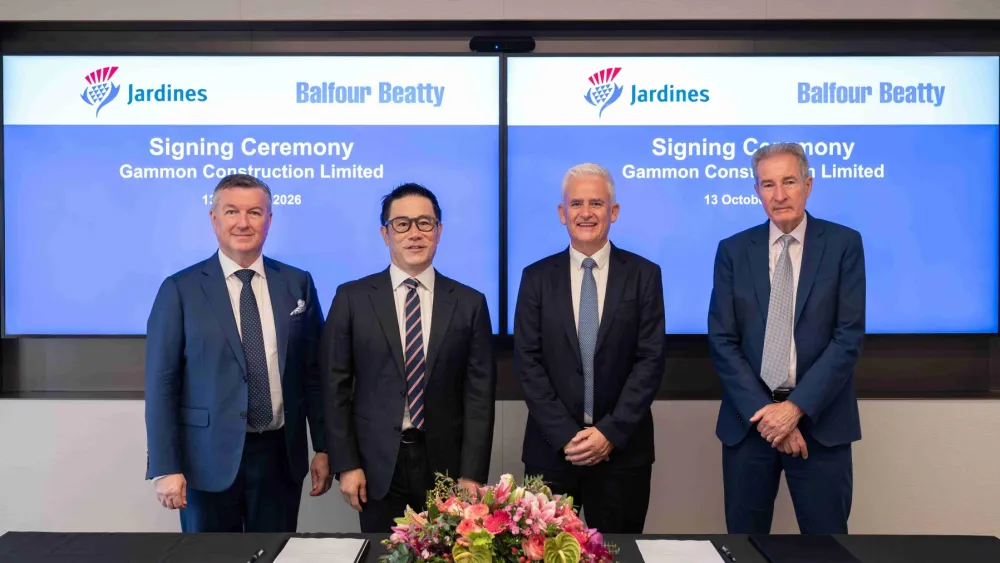
Chiu cited Jardine Matheson Holdings Ltd., which has reportedly sold more than $14b (US$1.8b) of Hong Kong property assets and is seeking buyers for its KFC and Pizza Hut franchises in Hong Kong and Taiwan.
Other deals include Swire Pacific Ltd.’s divestment of Swire Coca-Cola USA for $30.6b (US$3.9b), and China Travel International Investment Hong Kong Ltd.’s planned spin-off and separate listing of its Hong Kong and Macau business units.
Elaine Tan, senior manager for deals intelligence at the London Stock Exchange, said asset sales linked to CK Hutchison Holdings Ltd helped drive first-quarter activity.
One of the biggest transactions involved the sale of UK Power Networks Holdings Ltd., whilst CK Hutchison sold its remaining 49% stake in Vodafone UK Ltd. for $45.4b (US$5.8b), she said in an email.
“These transactions lifted energy and power deals, which accounted for 58.7% of total M&A value at $170 b (US$21.7b), up 89.5% from a year earlier,” Tan said.
Meanwhile, logistics transactions could also encourage more tie-ups in shipping and trade, citing Poseidon Corp., the holding company of Seaspan Corporation.
Tan cited Ocean Network Express Pte. Ltd., which agreed to raise its stake in Poseidon to 48.9%, whilst Yangzijiang Shipbuilding (Holdings) Ltd. agreed to buy a 10% stake.
“Overall, Hong Kong’s M&A activity remains defined by strategic capital rotation and a concentrated set of value-defining transactions,” she added.
The stronger start marks a turnaround from 2025, when no M&A deals were recorded during the first five months of the year, according to Neha Singh, co-founder and CEO at Tracxn Technologies Ltd.
“Hong Kong recorded five acquisitions in January 2026 alone,” she told Hong Kong Business via Zoom.
Singh said fintech companies have become bigger acquisition targets, with strategic buyers from the US, Australia, and the UK driving activity.
Recent transactions included Payward, Inc.’s acquisition of Reap Technologies Holdings Ltd., TP ICAP Group Plc’s acquisition of Vantage Capital Markets, and Clear Street LLC’s acquisition of BOOM Securities (H.K.) Ltd.
Singh added that the city’s strength in stablecoins and specialised fintech segments has made such firms more attractive to global acquirers seeking market access.
Chiu said the recovery is also being supported by mainland Chinese companies using Hong Kong as a base for overseas acquisitions, stronger private equity activity, and a healthier initial public offering (IPO) market.
Companies that recently listed are increasingly using IPO proceeds to fund acquisitions, whilst private equity firms face pressure to deploy capital as exit conditions improve, she added.
London Stock Exchange data showed Hong Kong’s new and secondary listings raised $104b (US$13.3b), more than five times the amount raised a year earlier. Chinese companies accounted for almost all of the proceeds, or around $103.9b (US$13.26b).
At least 23 first-time listings raised $36.84b (US$4.7b), up 139.2% YoY, whilst 15 secondary listings raised $66.62b (US$8.5b), a 20-fold increase, it added.
Chiu said state-linked capital is also anchoring deal activity, with the Hong Kong Investment Corporation investing in over 190 projects in areas such as hard and core technology, biotechnology, new energy, and green technology.
Dealmakers are also watching the impact of Chinese regulations on foreign investment, which take effect on 1 July.
Cyan Sze, a partner for corporate finance and M&As at KPMG China, said the rules, published by the State Council on 1 June, introduce stricter scrutiny of technology exports, data security, red chip structures and offshore vehicles.
“This could lead to tougher negotiations over break-up fees and regulatory conditions,” she said in an emailed reply to questions.
Sze said the rules could boost Hong Kong’s role as a route for mainland outbound acquisitions, but they could also lengthen transaction timelines.
It could also trigger restructuring of offshore holding companies and push more groups toward domestic M&A as traditional IPO routes face heavier regulatory hurdles, she added.
Deals facing geopolitical risks or regulatory scrutiny are already becoming harder to complete.
CK Hutchison’s planned $149b (US$19b) sale of Panama port assets to a consortium led by BlackRock, Inc. remains deadlocked, whilst the company also abandoned plans to sell PARKnSHOP.
New World Development Company Ltd. is another company being closely watched after Blackstone walked away from a proposed $31.3m (US$4b) acquisition in May.
Sze said investors should watch further portfolio reviews by major groups, including Jardine Matheson and New World Development, private equity deal flow, and how newly listed companies deploy IPO proceeds over the rest of the year.















 Read Here
 Advertise
 Sign Up