
IPOs spur bank hiring rebound
Workforce across 15 lenders fell 0.73% to 74,376 in 2025.
Hong Kong’s banking industry is experiencing renewed hiring this year, driven by a capital market rebound and automation projects, after total headcount across major lenders declined slightly in 2025, recruitment executives said.
Workforce across 15 major banks in Hong Kong fell 0.73% year on year to 74,376 employees at end-2025, according to data compiled by Asian Banking & Finance.
Recruiters said the flat headline figure masks a shift in hiring demand toward deal execution, trading, compliance, and technology roles as initial public offerings (IPO) increase and financial institutions expand automation programmes.
“Banking has been bouncing back,” Eric Zhu, director of financial services for Greater China at Morgan McKinley Ltd., told Asian Banking & Finance.
He said market activity improved between the last quarter of 2025 and the start of 2026 as more companies prepared listings on the Hong Kong Stock Exchange, lifting demand for deal professionals, engineers, and trading specialists. He added that rising transaction volumes have reinforced demand for execution and post-trade operational roles.
Fiona Mak, senior managing director at Ambition Group Hong Kong Ltd. & AmbTech, said sanction monitoring, financial crime prevention, and risk analysis teams are expanding quietly across institutions as banks respond to faster shifts in global market conditions and rising cross-border exposure risks.
She said private banking, wealth management, and family office hiring are also strengthening, with some expatriate professionals returning to Hong Kong from other financial centres.
She noted that geopolitical tensions have supported inflows into the city, although it remains too early to determine whether the trend could be sustained.
Mak said middle- and back-office hiring has become more selective as banks tighten cost controls. She said institutions are increasingly relying on contract staffing and flexible hiring models rather than expanding permanent headcount in support functions.
Capital markets have also supported hiring in front-office functions, particularly stock trading and structured products, Toby Miles, associate director of technology at Ambition Hong Kong, said in a Microsoft Teams call. He added that trading skills remain in demand as turnover increases across asset classes.
Regulatory complexity across multiple jurisdictions is also contributing to demand for compliance professionals, Miles said, noting that banks are expanding risk and assurance functions amidst tightening oversight requirements across financial services.
“It’s not just about hiring technologists within artificial intelligence (AI),” Miles said. “Banks are also looking for professionals in AI policy, legal, and compliance.”
This reflects a broader shift in hiring priorities, where banks are integrating governance and regulatory functions into technology deployment strategies rather than treating them as separate disciplines, he pointed out.
Automation is also reshaping hiring structures across the industry. Miles said junior roles are increasingly exposed to replacement by AI systems as banks prioritise revenue-generating positions and streamline operational workflows.
“There is a high possibility that more junior roles in banks will be taken up with AI in the next couple of years,” Miles said, adding that firms are already redesigning workflows to integrate machine-assisted analysis and decision support.
Zhu said banks are experimenting with models where AI tools replicate parts of analyst and trading workflows, reducing the size of support teams whilst increasing compensation for senior talent with high productivity.
“What the banks are thinking right now is how to duplicate the mind of a particularly good analyst,” Zhu said. “They're probably cutting down the job volume but pumping up the salary to hire those worthy people.”
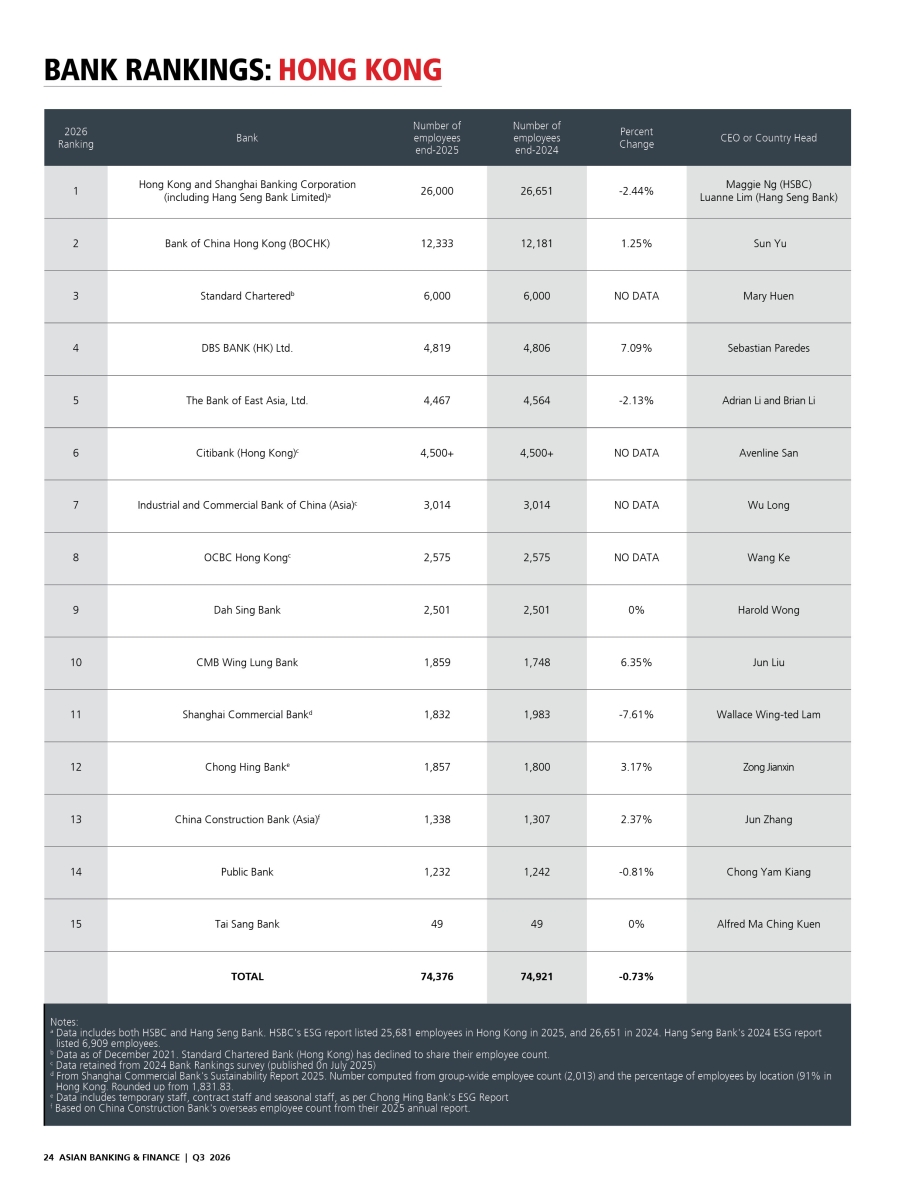
HSBC Holdings Plc is considering global job cuts of about 20,000 roles, according to Bloomberg News, citing people familiar with the matter. Most of the cuts are expected in middle and back-office functions as the bank expands AI deployment across operations.
HSBC employs about 26,000 staff in Hong Kong, including employees of Hang Seng Bank Ltd., based on industry estimates compiled from public disclosures and sector data.
Bank of China (Hong Kong) Ltd. remained the second-biggest employer in the city’s banking sector with 12,333 employees at end-2025, up 1.25% year on.year.
DBS Bank (Hong Kong) Ltd. employed 4,819 staff in the city at end-2025, whilst CMB Wing Lung Bank posted one of the strongest workforce increases among surveyed lenders over the same period.
DBS Bank (HK) Ltd. also announced plans this year to expand wealth management capacity across Asia, including wealth centres in selected markets, as part of a broader push to capture fee-based income growth in the region.
Recruitment executives said banks are increasingly prioritising franchise-based revenue models, including asset management and advisory services, where institutions earn fees rather than deploying balance-sheet capital in risk-intensive activities.
Zhu said uncertainty driven by geopolitical risks, including trade policy shifts and global tensions, has accelerated the shift toward advisory and fee-generating businesses.
He said banks are reducing exposure to proprietary trading and limiting underwriting activities where capital is at risk, whilst increasing focus on wealth management and structured advisory services.
‘Work from anywhere’
International hiring models are also evolving. Zhu said banks are increasingly getting senior talent from other financial hubs without requiring relocation to Hong Kong, reflecting a shift toward distributed workforce structures.
Miles described this as a “work from anywhere” model, noting that hybrid arrangements remain common even as office attendance rises across the sector.
Mak said workplace benefits are becoming a differentiating factor in talent competition, with banks and hedge funds offering structured meals, wellness programmes, and in-house catering to attract and retain staff.
She said some firms provide dedicated kitchens and chefs, which candidates increasingly view as a signal of workplace investment and culture quality in competitive hiring markets.
Miles said flexible work arrangements remain widespread across financial institutions, although firms are gradually increasing in-office requirements for client-facing and trading roles.
He added that language skills are becoming more important as mainland capital flows into Hong Kong increase, with Mandarin now carrying more weight alongside English and Cantonese in hiring decisions.
Mak said training support, subsidised courses, and upskilling programmes are becoming more important for job seekers, especially younger professionals entering the industry.
Recruiters said banks are competing not only within financial services but across sectors for talent, with technology firms, hedge funds, and digital platforms drawing from the same candidate pool.
Zhu said banks are no longer seen as the top employer for younger candidates, pushing institutions to improve pay and career development paths.
He added that firms are willing to pay more for top performers whilst cutting headcount in less productive roles.
Recruiters said this trend is expected to continue as AI use rises and banking operations shift to more efficient, automated, and revenue-focused models.























 Read Here
 Advertise
 Sign Up