Hong Kong's wealth ambitions extend beyond $3.3t in assets
Mass affluent clients drive growth alongside high-net-worth individuals.
Hong Kong needs to look beyond assets under management and strengthen its broader wealth management ecosystem to capture the next wave of wealth inflows, said Jasper Yip, head of corporate and institutional banking for Asia-Pacific and head of Greater China.
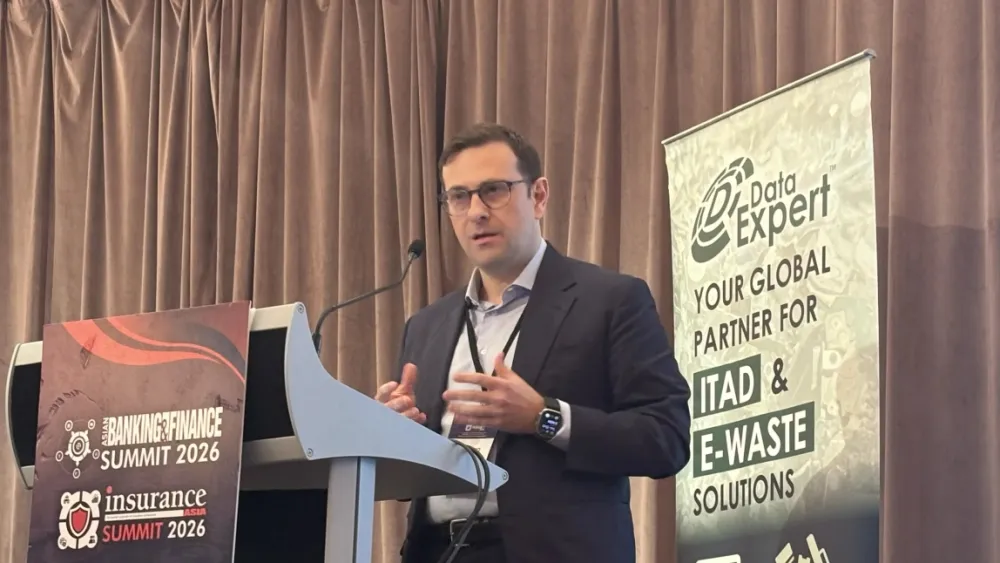
“The question is less about whether China will grow or how big it is going to grow, but rather what will grow and what opportunities we can capture,” Yip said in his keynote address at the Asian Banking & Finance and Insurance Asia summit on 5 November in Hong Kong.
Hong Kong has overtaken Switzerland as the world's largest offshore wealth management centre in 2025, with approximately US$3.3t (HK$25.9t) in assets.
The city has also attracted an estimated US$200b (HK$1.6t) in net wealth inflows in 2025.
Yip said growth was increasingly coming from mass affluent clients alongside high-net-worth individuals, creating new opportunities for banks, insurers, and wealth managers.
More than half of Chinese high-net-worth individuals are business owners, generating demand for financial services that combine corporate financing, wealth management, and investment planning, he added.
Their needs also extend beyond investment returns. Yip cited a survey in which 62% of respondents prioritised access to higher-quality global healthcare services, compared with 53% who cited long-term investment returns.
He also highlighted opportunities arising from China's changing economic structure, particularly its shift towards innovation-led growth and the international expansion of Chinese businesses.
Although China's GDP growth has moderated to around 5%, its annual economic expansion remains significant, estimated at approximately US$1.1t (HK$8.6t).
Yip also forecast that trade between China and ASEAN could reach US$1.3t (HK$10.2t) by 2030, creating further opportunities for financial institutions operating across the region.
Meanwhile, Yip highlighted the potential of renminbi (RMB) internationalisation, saying greater use of the currency in global trade and payments would need to be supported by deeper capital markets.
The outstanding value of RMB bonds issued by Mainland and Hong Kong entities stands at around US$26t (HK$204.0t), which he expects to triple as investor participation increases.
Further market development will require stronger liquidity, price discovery, interest rate hedging tools, and collateral infrastructure, he said.
“I don't think this is going to be about issuing just more bonds; it’s going to be building an ecosystem that requires both the market infrastructure, the buy side and the sell side, to really come together,” Yip said.
Yip said Hong Kong could play a greater role in developing this ecosystem and connecting international investors with Chinese assets.
“The opportunity for China and Hong Kong is going to evolve in the next chapter. It's still going to be about internationalisation, and it's going to be about creating international assets that are fungible and relevant, investable in the global arena,” he said.












 Read Here
 Advertise
 Sign Up