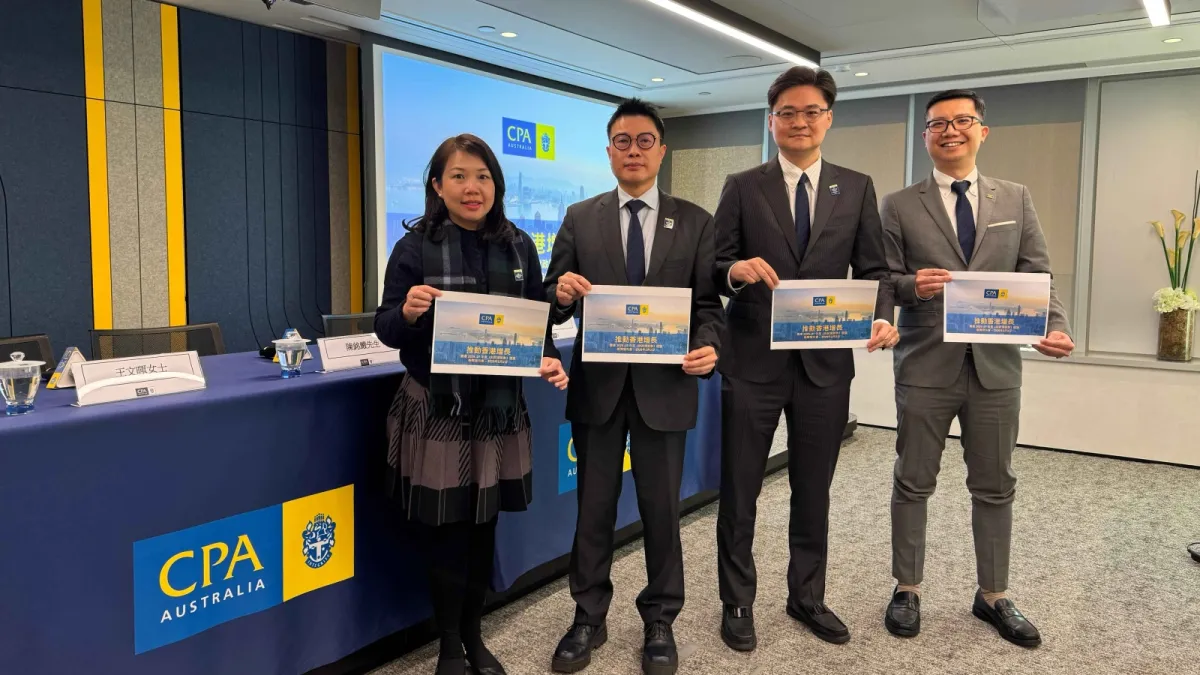
Unified tax incentive pushed in Hong Kong to lure global treasury hubs
This forms part of a four-pillar strategy to fuel growth in the city.
The Hong Kong government could create a unified tax incentive framework for Corporate Treasury Centres and regional headquarters, CPA Australia recommended, to allow the government to reinforce the city's position as a bridge between China and international markets.
This includes engaging with Mainland authorities to clarify that corporate re-domiciliation to Hong Kong will not trigger Mainland tax liabilities.
The proposal forms part of a four-pillar strategy submitted for consideration in Hong Kong's 2026/27 Budget, designed to drive economic recovery and enhance long-term competitiveness.
This comes after Hong Kong recorded an approximate $0.9b fiscal deficit for 2025/26, alongside estimated fiscal reserves of $653b, according to a press release.
The strategy focuses on strengthening Hong Kong’s role as a global gateway, enhancing the wealth management ecosystem, supporting small businesses, and improving residents’ quality of life.
Tax exemptions on interest income and trading profits derived from these infrastructure bonds were recommended, alongside an "IPO Connect" scheme and tax deductions for expenses linked to initial public offerings (IPO) of companies listing on the Hong Kong Exchange Main Board.
To maintain Hong Kong’s competitive edge as a financial hub, CPA Australia calls for a preferential 8.25% profits tax rate for Single and Multi-Family Offices and fund managers.
The group also proposes aligning investment asset classes under the family office tax regime with those of the Capital Investment Entrant Scheme, the press release said.
The proposal also suggests issuing approximately $15.6b (US$2b) in international bonds with varying maturities for the Northern Metropolis.
In the trade sector, CPA Australia recommends expanding the list of qualifying commodities to include silver and rare-earth materials, and extending tax concessions to cover derivative-driven transactions.
To promote philanthropy, the submission suggests removing the 35% cap on cash donation deductions and introducing a 300% enhanced deduction for contributions to designated funds, such as the Community Care Fund.
Recognising the cost pressures on small and medium enterprises (SMEs), CPA Australia recommends doubling the cap for the 8.25% concessional tax rate to $4m in assessable profits from $2m.
The body also calls for extending the SME Financing Guarantee Scheme beyond March 2026, the press release said.
CPA Australia proposes relaunching a revamped Technology Voucher Programme to help SMEs accelerate digitalisation and adopt artificial intelligence.
“Strengthening R&D-related tax incentives is equally important in driving innovation. We therefore propose increasing the cap for the highest rate of the research and development (R&D) super tax deduction by raising the threshold for the 300% deduction on qualifying R&D expenditure from $2m to $4m,” said Janssen Chan, Co‑Chairperson of CPA Australia’s Greater China Taxation Committee.
The submission includes a 100% salaries tax rebate for 2025/26 capped at $6,000 and a new $60,000 tax deduction for working families employing domestic helpers for child or elderly care.
To support lifelong learning, CPA Australia recommends increasing the Continuing Education Fund subsidy ceiling to $30,000 per eligible applicant, whilst raising the cap on the self-education tax deduction to $150,000 per year.
A tax deduction of up to $2,000 for sports-related expenses was also included in the proposal.
CPA Australia representatives stated that these measures aim to ensure Hong Kong remains a sustainable, innovation-driven, and inclusive city, whilst navigating current fiscal challenges.
(US$1 = HK$7.80)

















 Read Here
 Advertise
 Sign Up