Hong Kong could beat IMF’s 3.8% growth forecast, Finance chief says
The IMF expects the region’s growth to be significantly faster than the global average.
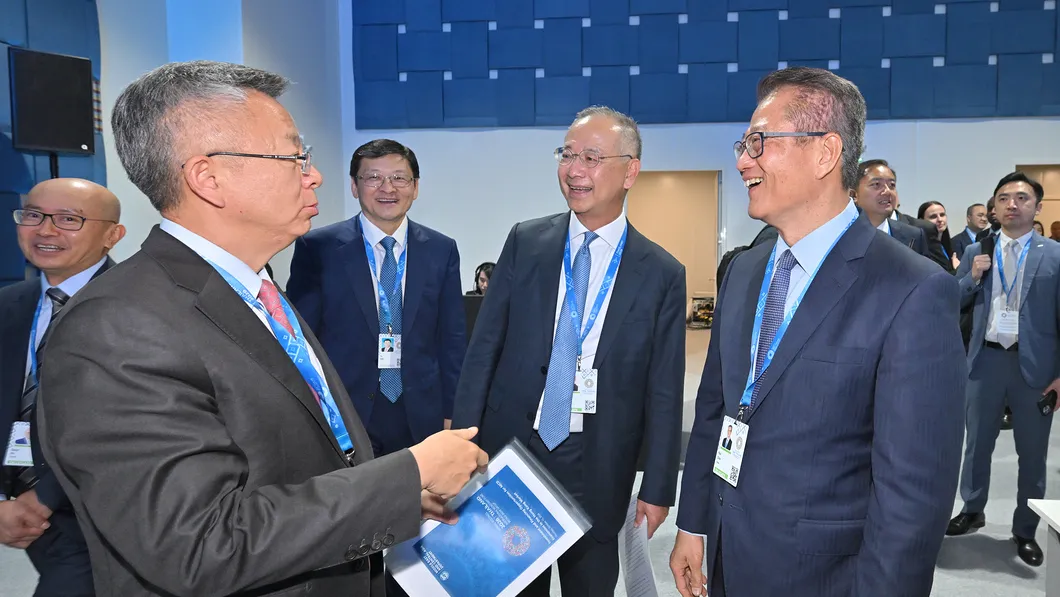
The International Monetary Fund (IMF) improved its initial forecast of Hong Kong’s economic growth to 3.8%, but the city sees a higher outcome, said Financial Secretary Paul Chan in a blog post on 18 October.
Chan discussed the annual meetings of the IMF and the World Bank Group in Bangkok in his blog, tackling the future of the global economy between the artificial intelligence (AI) surge and high energy prices amidst Middle East conflict.
The IMF predicted that global economic growth will cool down from 3.5% to 3.1% year on year, but said that Asia’s growth is significantly faster than the global average, thus the forecast for Hong Kong.
Chan agrees, listing interconnected issues such as geopolitical tensions, energy supply shortages, climate change, inflation, trade frictions and tight financial conditions as challenges to the economy.
He added that at the annual meeting, two contrasting scenarios were discussed: 30% global import growth in the past two years from AI-related goods and job instability as approximately 1.2 billion young people enter the job market in the next 10-15 years.
To support the global economy, the secretary proposed focus on three aspects: facilitating long-term capital, expanding currency options and managing and sharing risks.
He said that Hong Kong’s initial public offering in the first nine months has reached nearly $392.4b (US$50b).
The city is also expanding currency options, as more countries in the Global South trade with mainland China, resulting in large holdings of RMB.
He said that based on risk diversification considerations and relatively low RMB interest rates, more developing economies are issuing RMB bonds in Hong Kong.
Chan adds that mainland enterprises’ technology requires a platform to go global, like the Jiangsu-Hong Kong cooperation. Currently, 129 Jiangsu firms are listed in the city, with cumulative market capitalisation exceeding $1.644t (RMB1.4t).
He visited Nanjing and Bangkok last week, and said that developing economies need capital and technology — both of which Hong Kong can provide, positioning the city to help other countries develop whilst enhancing its own competitiveness.
The IMF-World Bank annual meeting will continue in Hong Kong this week, the secretary said, further deepening exchanges with representatives across various regions.
$1 USD = 7.848 HKD ; ¥1 RMB = 1.175 HKD as of 20 October.













 Read Here
 Advertise
 Sign Up