Central Asia leverages China and the West for growth
The SCO summit spotlights Central Asia’s effort to deepen economic ties whilst maintaining balance.
The Shanghai Cooperation Organisation (SCO) summit in Tianjin marked a major diplomatic milestone for China as over 20 global leaders approved the creation of a new development bank and measures to expand renminbi-denominated trade. The gathering reflected Beijing’s ambition to promote a multipolar world order, even as Central Asian states maintained their focus on pragmatic investment-driven partnerships.
All five Central Asian leaders endorsed the summit’s declaration, which some Western commentators, including Finland’s President Alexander Stubb, viewed as a challenge to the “West-dominated global system.” However, regional leaders have made clear that their objective is to attract economic investment without becoming dependent on any single power.
Once firmly within Russia’s economic orbit, Central Asia has increasingly turned to China as its leading investor and trading partner. Since 2020, Beijing has surpassed Moscow and the European Union (EU), accounting for nearly 40% of the region’s foreign trade. Trade volumes reached about HK$741b (US$95b) in 2024, outpacing combined EU and Russian totals.
China’s interest in the region extends beyond hydrocarbons and minerals. Its projects now include Uzbekistan’s HK$7.8b (US$1b) Huawei surveillance initiative and a BYD electric vehicle plant, signalling a shift towards technology and manufacturing sectors. The region’s strategic importance also lies in its energy corridors—pipelines from Turkmenistan and Kazakhstan deliver gas directly to China, reducing reliance on vulnerable maritime routes.
European response
Central Asia remains integral to China’s Belt and Road Initiative (BRI). Around 85% of China–Europe rail freight passes through Kazakhstan, and the HK$39b (US$5b) China–Kyrgyzstan–Uzbekistan railway under construction is expected to shorten transit times to Europe by up to two weeks.
The West, meanwhile, is recalibrating its engagement. At the 2025 Samarkand summit, the EU pledged HK$99.6b (€12b) under its Global Gateway programme, including HK$83b (€10b) for the Trans-Caspian Transport Corridor. The United States, through its C5+1 framework, is investing in gas and renewable energy projects in Uzbekistan and backing a HK$31.2b (US$4b) locomotive deal with Kazakhstan. Washington has also deepened cooperation on critical minerals and supported Uzbekistan’s upcoming HK$156b (US$20b) mining company IPO in London.
Kyrgyzstan’s multi-vector strategy
Kyrgyzstan exemplifies the region’s nuanced diplomacy. Bakai Bank, the country’s largest private lender, has engaged with US Treasury Secretary Scott Bessent and major financial institutions such as BlackRock and Bank of America to attract American investment.
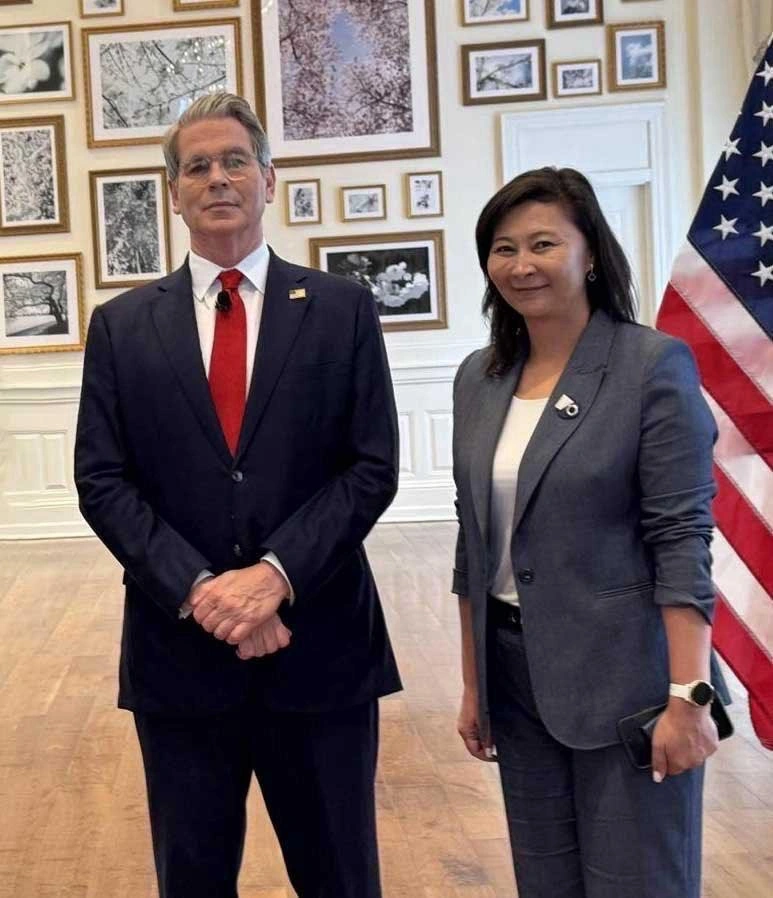
Scott Bessent, US Treasury Secretary, and Umut Abakirova, Bakai Bank CEO
Simultaneously, it has expanded ties with China and neighbouring states to strengthen trade and logistics links. CEO Umut Abakirova has positioned Kyrgyzstan as a financial gateway for Western and Asian investors seeking entry into Central Asia.
This approach has yielded strong results. In 2024, Kyrgyzstan’s economy grew by 9%, Tajikistan by 8%, Uzbekistan by 6.5%, and Kazakhstan and Turkmenistan by 5% each. Kyrgyzstan’s move from remittance dependency to industries such as energy, mining, and digital technology reflects the region’s evolving economic ambitions.
Beijing and Brussels
Despite perceptions of rivalry, China and the EU remain deeply interconnected—China is the EU’s largest supplier of goods and its third-largest export market. This interdependence benefits Central Asia, allowing it to avoid binary alignments and instead pursue balanced diplomacy to attract investment from both sides.
Whilst the Tianjin summit reinforced China’s influence, Central Asia’s future hinges not on bloc politics but on its capacity to maintain equilibrium between global powers. By doing so, the region positions itself as both a strategic corridor and a vital player in shaping a more interconnected global economy.












 Read Here
 Advertise
 Sign Up